Dullahan
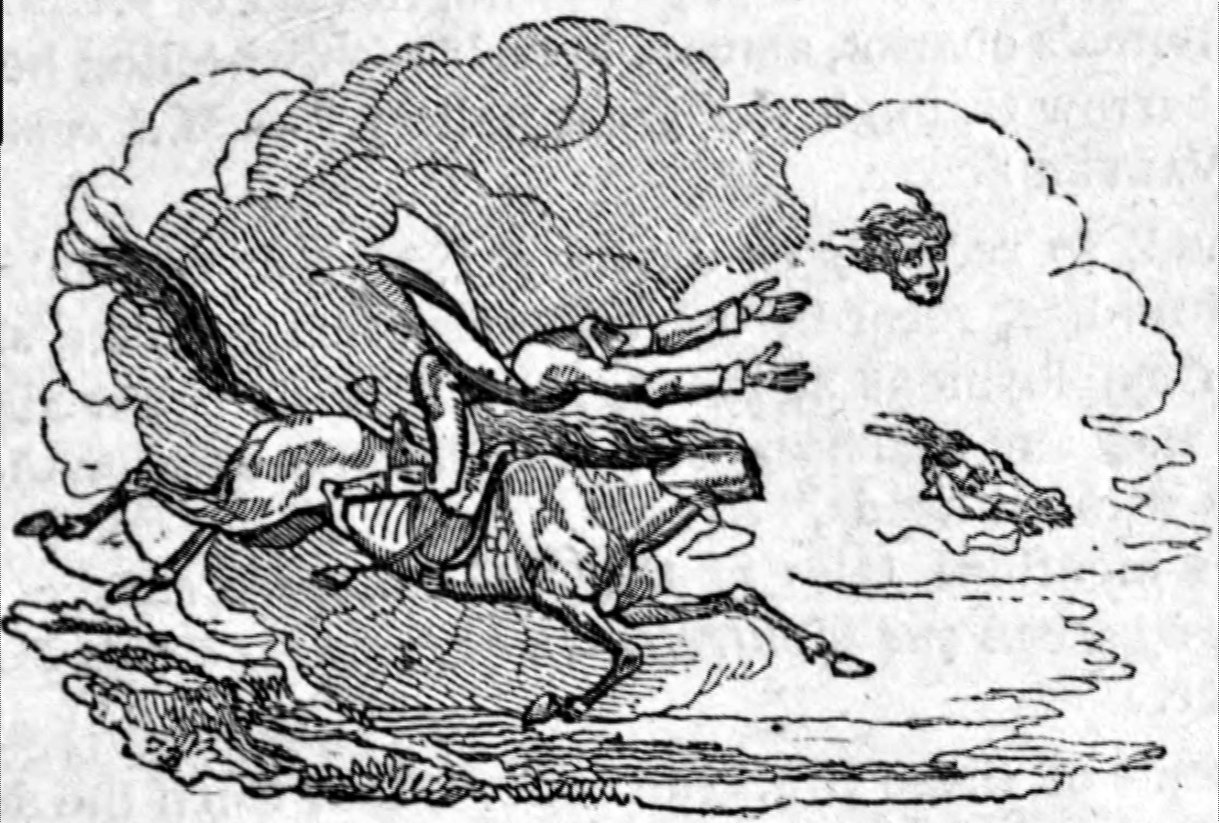
The Dullahan (Irish: Dubhlachan; dúlachán, /ˈduːləˌhɑːn/) is a supernatural figure in Irish folklore, often described as a headless rider mounted on a black horse or as a coachman carrying his own head. Because references to the creature are scarce in native sources, and it does not appear in the records of the Irish Folklore Commission, some scholars question whether the Dullahan was originally part of authentic Irish oral tradition.
Descriptions of the Dullahan vary, but he is usually portrayed as a headless horseman riding a black steed and holding his severed head under his arm or in his hand. The head is said to have a ghastly, unsettling appearance. In Thomas Crofton Croker’s tale The Headless Horseman, it is described as resembling a pale drumhead stretched tight over bone, with lifeless features, enormous blazing eyes, and a grotesque, corpse-like texture.
Modern storyteller Tony Locke of County Mayo adds that the Dullahan’s grin extends across the entire face, its jagged teeth bared, its eyes dart restlessly like flies, and its flesh reeks and decays with the color and consistency of mouldy cheese.
In some traditions, the Dullahan is associated with the Cóiste Bodhar or “Headless Coach,” a spectral carriage that serves as a harbinger of death. Accounts describe the coach as being driven by the Dullahan and constructed from macabre materials: axles made of human spines, wheels of thigh bones, and lanterns fashioned from hollowed skulls that contain burning candles. The hammercloth covering the coach is said to be damp, rotting funeral cloth, tattered by worms and decay.
William Butler Yeats explained that the coach was sometimes called the “deaf coach,” not because it was silent, but because of the heavy rumble of its wheels. Yet in other reports it passes as a soundless shadow, a deathly omen gliding through the night.
Legends hold that the Dullahan or his coach often appears near graveyards or burial vaults of the wicked, arriving at the doorstep of those fated to die. His arrival is thought to foretell death or disaster. In Croker’s story Hanlon’s Mill, for example, a man named Mick Noonan encounters a black coach drawn by six headless horses and driven by a headless coachman.
The following morning, news arrives that a local master has suddenly died. Other tales from County Cork describe the coach traveling between Castle Hyde and Ballyhooly or visiting homes in Doneraile, where any who opened the door risked being splashed with blood by the spectral driver.
The Dullahan is also said to wield a whip made from a human spine, which he lashes with such force that it can blind onlookers. In Croker’s story The Harvest Dinner, the coachman nearly strikes a witness blind in one eye. Croker suggested that the Dullahan attacks the eyes of witnesses because, lacking his own head, he seeks to rob others of their sight. Later storytellers reinforced this idea, emphasizing his desire to punish those who dare to look upon him.
Some accounts suggest that the Dullahan can see through his severed head and scan the countryside for those about to die. Others claim he can be driven away by gold, though this belief is not widely supported.
Croker’s Fairy Legends and Traditions of the South of Ireland (1828) preserved many of the earliest written accounts of the Dullahan, including variations where women also appear as headless riders. In the tale The Good Woman, a peasant named Larry Dodd offers a cloaked female a ride, only to discover she is a Dullahan. He collapses unconscious and awakens in church ruins surrounded by severed heads and headless riders of every class and station.
When he attempts to speak, his own head is struck from his body mid-sentence, only to be restored when he revives. In the end, Larry loses his horse to the Dullahan host.