Deborah Sampson
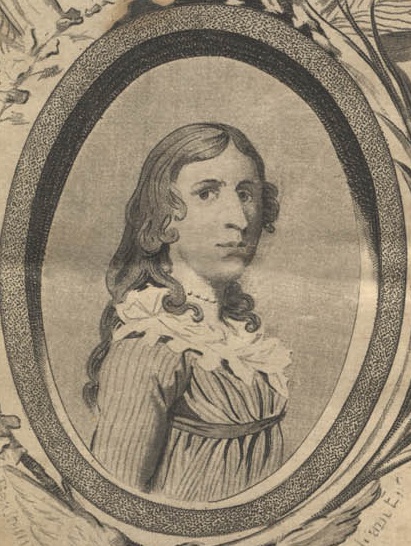
Deborah Sampson Gannett, also known by the variant spellings Deborah Samson or Deborah Sampson (December 17, 1760 – April 29, 1827), was a Massachusetts woman who achieved remarkable and courageous distinction by disguising herself as a man in order to enlist and serve in the Continental Army during the American Revolutionary War, at a time when women were strictly prohibited from military service and such deception, if discovered, could have resulted in severe punishment including imprisonment, public humiliation, or execution for fraud and deception of military authorities. Born in Plympton, Massachusetts, into a family of modest circumstances—her father abandoned the family when she was young, and she spent years working as an indentured servant—Sampson enlisted in the Continental Army in 1782 under the male name Robert Shirtliff (sometimes spelled Shurtleff or Shirtleff in various period documents, reflecting inconsistent spelling conventions of the era). To maintain her masculine disguise, she bound her breasts, adopted male clothing and mannerisms, deepened her voice, and successfully convinced recruiting officers and her fellow soldiers that she was a young man.
Her height (approximately 5 feet 7 inches, unusually tall for women of her era and within the normal range for male soldiers), her physical strength developed through years of farm labor, and her lack of facial hair (which she could attribute to youth) helped make her disguise credible. Sampson served in uniform for an extraordinary seventeen months before her biological sex was discovered in 1783. During her service, she participated in several military engagements and sustained combat wounds on at least two occasions.
According to her own later accounts, she treated some of her injuries herself rather than seeking medical attention that would have required physical examination and exposed her secret. Her disguise was finally penetrated not through combat injury but when she contracted a severe fever while her unit was stationed in Philadelphia. The illness rendered her unconscious or delirious, and when Dr.
Barnabas Binney treated her, he discovered her biological sex. However, rather than immediately exposing her, Dr. Binney kept her secret temporarily and arranged for her to recover at his home, demonstrating sympathy for her situation and perhaps admiration for her service and courage.
After Sampson's true identity was eventually made known to her military commander—through what exact process and by whose revelation remains somewhat unclear in historical accounts—she was honorably discharged from the Continental Army at West Point in October 1783. The fact that she received an honorable discharge rather than facing court-martial, imprisonment, or other punishment suggests that her commanders recognized the unusual nature of her case, appreciated her military service, and perhaps felt that the war's conclusion (the Treaty of Paris formally ending the Revolution was signed in September 1783) made harsh treatment of this unusual soldier unnecessary or inappropriate. After her military discharge, Sampson returned to civilian life and met Benjamin Gannett, a farmer from Sharon, Massachusetts, whom she married in 1785.
The couple had three biological children and also adopted a fourth child, and Sampson settled into conventional domestic life as a wife and mother—roles that contrasted dramatically with her earlier military service and masculine persona. However, her extraordinary wartime experiences and the growing public knowledge of her unusual story meant she could not simply disappear into anonymous domesticity. In 1802, Sampson embarked on what appears to have been one of the first lecture tours undertaken by a woman in American history, traveling to various cities and towns to speak publicly about her Revolutionary War experiences, her motivations for disguising herself as a man and joining the army, and her observations about military life and the struggle for American independence.
These lectures, which sometimes included Sampson demonstrating military drill movements in uniform, represented a bold and unprecedented public role for a woman in early republican America, where respectable women were expected to remain in domestic spheres rather than speaking publicly to mixed audiences of men and women. Her lectures attracted substantial audiences curious to see and hear from this unusual woman who had violated gender conventions to serve her country, and they provided her with income to supplement her family's farm revenues. Sampson also petitioned for military pension benefits based on her service, facing bureaucratic obstacles because pension laws assumed all Continental Army soldiers were men.
With the assistance of Paul Revere, who wrote letters supporting her petition and attesting to her service and character, and through appeals to the Massachusetts legislature, she eventually received some pension payments, though the amounts were modest and irregular. Her struggle for proper recognition and compensation illustrated the challenges faced by a woman who had performed military service in a system that had no legal or administrative framework for acknowledging female soldiers. Deborah Sampson Gannett died in Sharon, Massachusetts, on April 29, 1827, at age sixty-six.
Her grave remained relatively obscure for many decades, but during the twentieth century, as feminist historians rediscovered forgotten women's contributions to American history and as society became more receptive to recognizing women's military service, Sampson's story gained renewed attention and official recognition. She was proclaimed the Official Heroine of the Commonwealth of Massachusetts on May 23, 1983, exactly two centuries after her military service ended, and in 1985, the United States Capitol Historical Society posthumously honored "Deborah Samson" with its Commemorative Medal, using the variant spelling of her name. These belated official honors acknowledged not only her courage and patriotism in serving during the Revolution but also her significance as a woman who challenged rigid gender boundaries, demonstrated that women could perform the same military duties as men when given the opportunity, and pioneered the pathway—however difficult and controversial—for women's eventual full integration into the American military in the twentieth and twenty-first centuries, making her a symbolic foremother for all women who have since served in the United States armed forces.