Cynocephaly
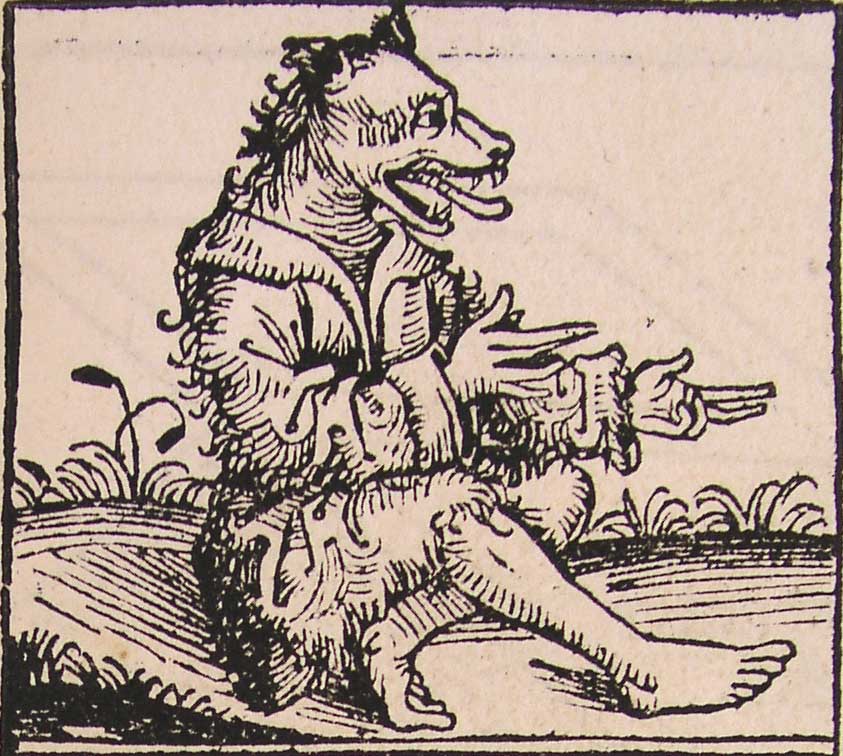
Cynocephaly, or cynocephalus (/saɪnoʊˈsɛfəli/), refers to the characteristic of having the head of a canine, usually a dog or jackal, on a human body. The term literally means “dog-headedness,” and this phenomenon appears widely in myth, legend, and literature across multiple cultures. Cynocephalics are documented in the myths of ancient Egypt, Libya, Greece, India, and China, as well as in medieval accounts from both the East and Europe.
In modern popular culture, they also appear as characters in books, comics, and graphic novels. Cynocephaly is distinct from lycanthropy (werewolfism) and from talking dogs.
In addition to mythical humans, the Greeks and Romans used the term cynocephalus to describe certain species of apes, believed to have been baboons.
The concept of cynocephaly was familiar to the ancient Greeks through Egyptian religious iconography. Gods such as Duamutef (son of Horus), Wepwawet (the opener of the ways), and Anubis (the god of the dead) were often depicted with jackal heads. The Greek word κῠνοκέφᾰλοι, meaning “dog-head,” also referred to sacred Egyptian baboons with dog-like faces.
These depictions were not intended to represent literal human-animal hybrids but instead illustrated the deities’ therianthropic ability to shift between human and animal forms. As Egyptologist Henry Fischer explained, “a lion-headed goddess is a lion-goddess in human form, while a royal sphinx is a man who has assumed the form of a lion.” Greek visitors may have misinterpreted such imagery, believing Egyptians worshipped dog-headed gods or that dog-headed humans existed in Egypt.
Reports of dog-headed human races also appear in Greek literature. In the fifth century BC, the physician Ctesias described cynocephali in India in his Indica. The Greek traveler Megasthenes wrote of dog-headed people living in the Indian mountains, who communicated by barking, wore animal skins, and survived by hunting.
Claudius Aelianus likewise mentioned Indian dog-headed tribes, noting that although they lacked speech and howled to communicate, they could understand the local language. Herodotus reported that ancient Libyans claimed such creatures lived in the eastern parts of their land, alongside headless men and other anomalies.
Some scholars suggest that the encounter between the Argonauts and cynocephali described in Greek legend may have taken place in what is now northern Serbia or southern Hungary. Greek writers also mention creatures called Hemicynes (“half-dogs,” from ἡμι, “half,” and κύων, “dog”).
Cynocephali appear in medieval Christian narratives as well. One legend tells of Andrew and Bartholomew preaching in Parthia and encountering “Abominable,” a citizen of a city of cannibals whose face resembled a dog’s. After baptism, he was freed from his dog-like form.
The medieval traveler Ibn Battuta recorded meeting people described as “dog-mouthed” during his journey, likely referring to the Mentawai people of an island between India and Sumatra, who practiced tooth sharpening. He wrote:
Fifteen days after leaving Sunaridwan we reached the country of the Barahnakar, whose mouths are like those of dogs. This tribe is a rabble, professing neither the religion of the Hindus nor any other. They live in reed huts roofed with grasses on the seashore, with abundant banana, areca, and betel trees.
Their men are shaped like ourselves, except that their mouths are shaped like those of dogs; this is not the case with their womenfolk, however, who are endowed with surpassing beauty. The men go mostly unclothed except for an ornamental pouch of reeds at the waist, while women wear aprons of leaves. Muslims from Bengal and Sumatra live in a separate quarter, conducting trade with the natives.
Water is carried on elephants from a distance, as the villagers will not allow merchants to fetch it themselves for fear of harm to women. Elephants are plentiful but can only be used with the sultan’s permission.