Crocotta
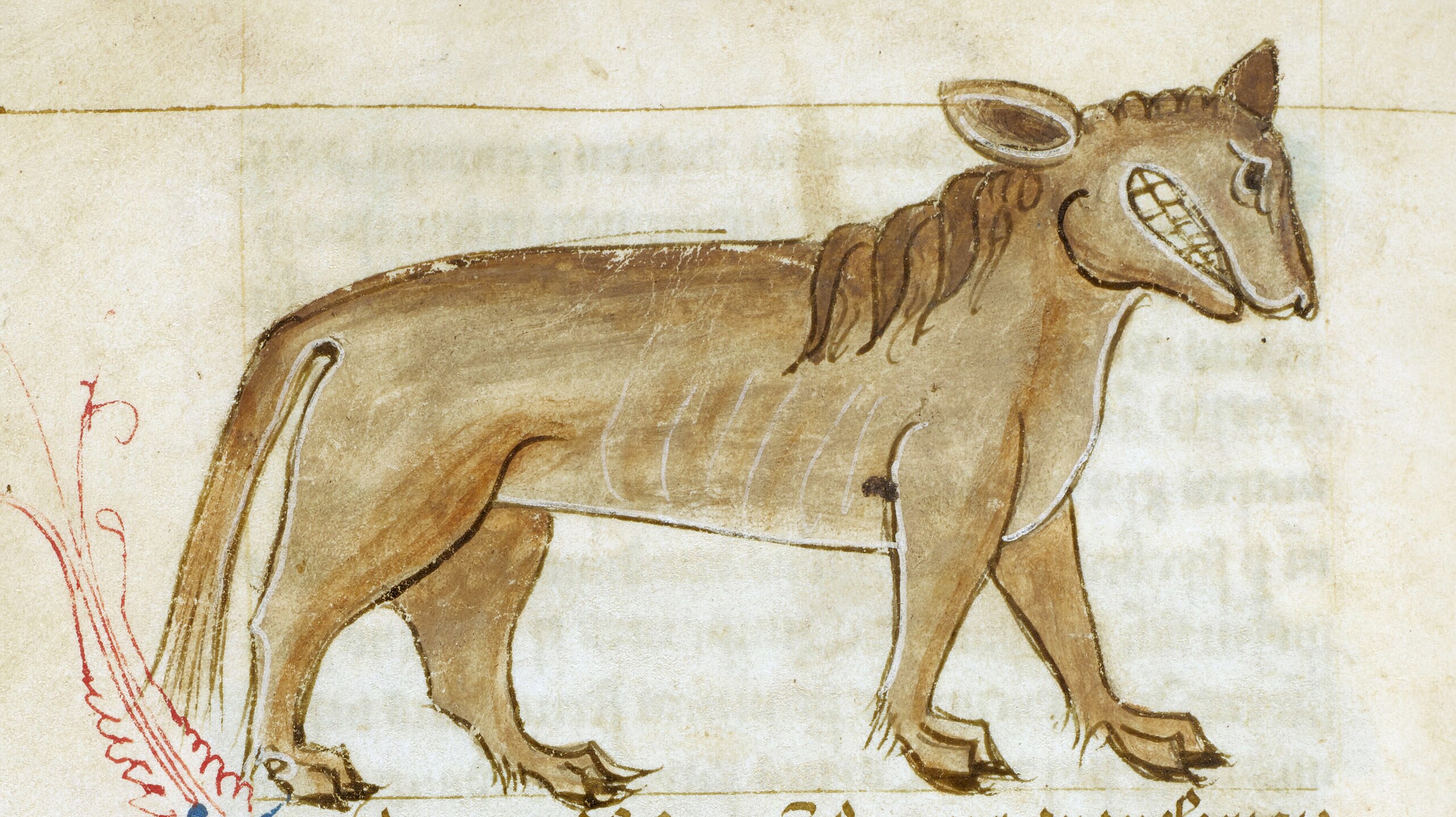
The crocotta, also known as the corocotta, crocuta, leucrocotta, or leucrotta, is a legendary beast described as a fearsome dog-wolf native to India or Aethiopia. Closely associated with the hyena, it was said to be a deadly enemy of both men and dogs.
The Greek geographer Strabo referred to the animal as the “crocuttas,” describing it as the offspring of a wolf and a dog (Geographica, XVI.4.16). The Roman author Pliny the Elder, in Natural History (VIII.72 and 107), claimed it was instead the hybrid of a hyena and a lion. According to Pliny, “When crossed with this race of animals (the hyena), the Ethiopian lioness gives birth to the corocotta, which mimics the voices of men and cattle. It possesses an unbroken ridge of bone in each jaw, forming a continuous tooth without any gums.”
Pliny also described a related creature, the leucrocotta, which he called the swiftest of all beasts. He wrote that it was the size of an ass, with the haunches of a stag, the neck, tail, and breast of a lion, the head of a badger, cloven hooves, and a mouth that opened back to the ears. Like the corocotta, it was said to have solid ridges of bone instead of teeth and to mimic human voices.
The Byzantine scholar Photius, summarizing Indica by the Greek physician Ctesias, wrote: “In Ethiopia there is an animal called crocottas, commonly known as the dog-wolf, of amazing strength. It is said to imitate the human voice, call men by name at night, and devour those who approach. It is as brave as a lion, as swift as a horse, and as strong as a bull. No steel weapon can harm it.”
The Roman writer Claudius Aelianus, in On the Characteristics of Animals (VII.22), also connected the hyena with the corocotta and repeated the claim that it could mimic human speech. The philosopher Porphyry, in On Abstinence from Animal Food (III.4), added that the “Indian hyena,” called crocotta by locals, could speak in an eerily human manner without training. He claimed it would approach houses at night, call out to individuals by name, and lure them away to be killed.
According to the Augustan History, the emperor Antoninus Pius displayed a corocotta at his decennalia in AD 148. The historian Cassius Dio credited the later emperor Septimius Severus with introducing the animal to Rome, describing it as an Indian species with the color and appearance of both a lioness and a tiger, combined with features of a dog and a fox.
In the Middle Ages, bestiaries blended and altered these ancient accounts, creating a variety of depictions for the creature. Some medieval sources claimed its eyes were striped gemstones that granted prophetic powers when placed under the tongue. The Aberdeen Bestiary describes the leucrota as a swift beast from India, the size of an ass, with the hindquarters of a stag and the chest and legs of a lion, and includes an illustration on Folio 15v.
The scientific name of the modern spotted hyena (Crocuta crocuta) was inspired by the mythological crocotta. Certain elements of the ancient descriptions align with real hyenas, which possess incredibly strong jaws, can consume a wide variety of foods, sometimes dig up human remains, and produce vocalizations that can sound disturbingly human. Folklore surrounding hyenas has often attributed to them powers such as changing sex, shape-shifting, and speaking like humans—traits that may have helped give rise to the enduring legend of the crocotta.