Christopher Columbus
Christopher Columbus (between 25 August and 31 October 1451–20 May 1506) was an Italian explorer and navigator from the Republic of Genoa who completed four voyages across the Atlantic Ocean under Spanish sponsorship by the Catholic Monarchs. His expeditions opened the door to widespread European exploration and colonization of the Americas and marked the first known European contact with the Caribbean, Central America, and South America. The name Christopher Columbus is the anglicized form of the Latin Christophorus Columbus.
Growing up along the Ligurian coast, he went to sea as a young man and traveled extensively, reaching as far north as the British Isles and as far south as present-day Ghana. He married Filipa Moniz Perestrelo, a Portuguese noblewoman who bore him a son, Diego, and he lived in Lisbon for several years. Later, he took Beatriz Enríquez de Arana, a Castilian woman, as his mistress, and she gave birth to his son Ferdinand.
Largely self-taught, Columbus possessed extensive knowledge of geography, astronomy, and history. He conceived a plan to reach the East Indies by sailing west across the Atlantic, hoping to tap into the profitable spice trade. Following the Granada War and Columbus's persistent appeals to various European courts, Queen Isabella I and King Ferdinand II of Castile finally agreed to sponsor his westward expedition.
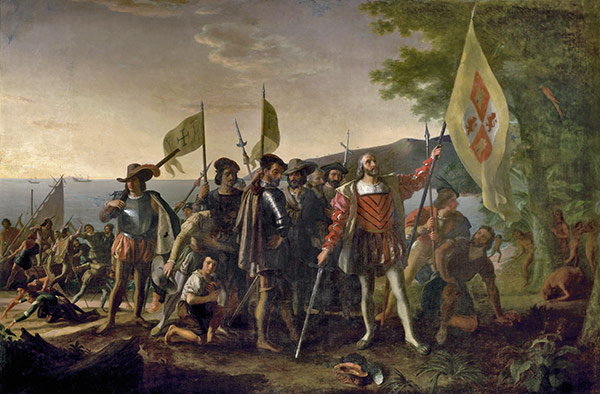
Columbus departed Castile in August 1492 with three ships and reached the Americas on 12 October, marking the end of what is now called the pre-Columbian era. He first landed on an island in the Bahamas known to its native inhabitants as Guanahani, then explored the islands now called Cuba and Hispaniola, establishing a settlement in what is today Haiti. He returned to Castile in early 1493 with captured indigenous people, and news of his voyage rapidly spread across Europe.
Columbus undertook three additional voyages to the Americas, exploring the Lesser Antilles in 1493, Trinidad and the northern coast of South America in 1498, and the eastern coast of Central America in 1502. Many of the geographical names he assigned, particularly to islands, remain in use today. He called the indigenous peoples he encountered indios, or Indians.
Whether he recognized that the Americas constituted an entirely separate landmass remains unclear; he never definitively abandoned his conviction that he had reached the Far East. As colonial governor, Columbus faced accusations of severe brutality from some contemporaries and was ultimately removed from his position. His troubled relationship with the Crown of Castile and its colonial administrators resulted in his arrest and expulsion from Hispaniola in 1500, followed by extended legal battles over the privileges he and his heirs claimed the Crown owed them.
Columbus's expeditions inaugurated centuries of exploration, conquest, and colonization that brought the Americas into the European sphere of influence. The exchange of plants, animals, precious metals, culture, human populations, technology, diseases, and ideas between the Old World and New World following his first voyage is known as the Columbian Exchange, named in his honor. These events and their lasting consequences are often identified as the beginning of the modern era.
Diseases introduced from the Old World contributed significantly to the depopulation of Hispaniola's indigenous Taíno people, who also suffered enslavement and other abuses under Columbus's administration. Growing public awareness of these historical realities has led to a reassessment of Columbus's legacy in Western culture, which traditionally celebrated him as a heroic discoverer. Numerous geographical locations bear his name.