Ceryneian Hind
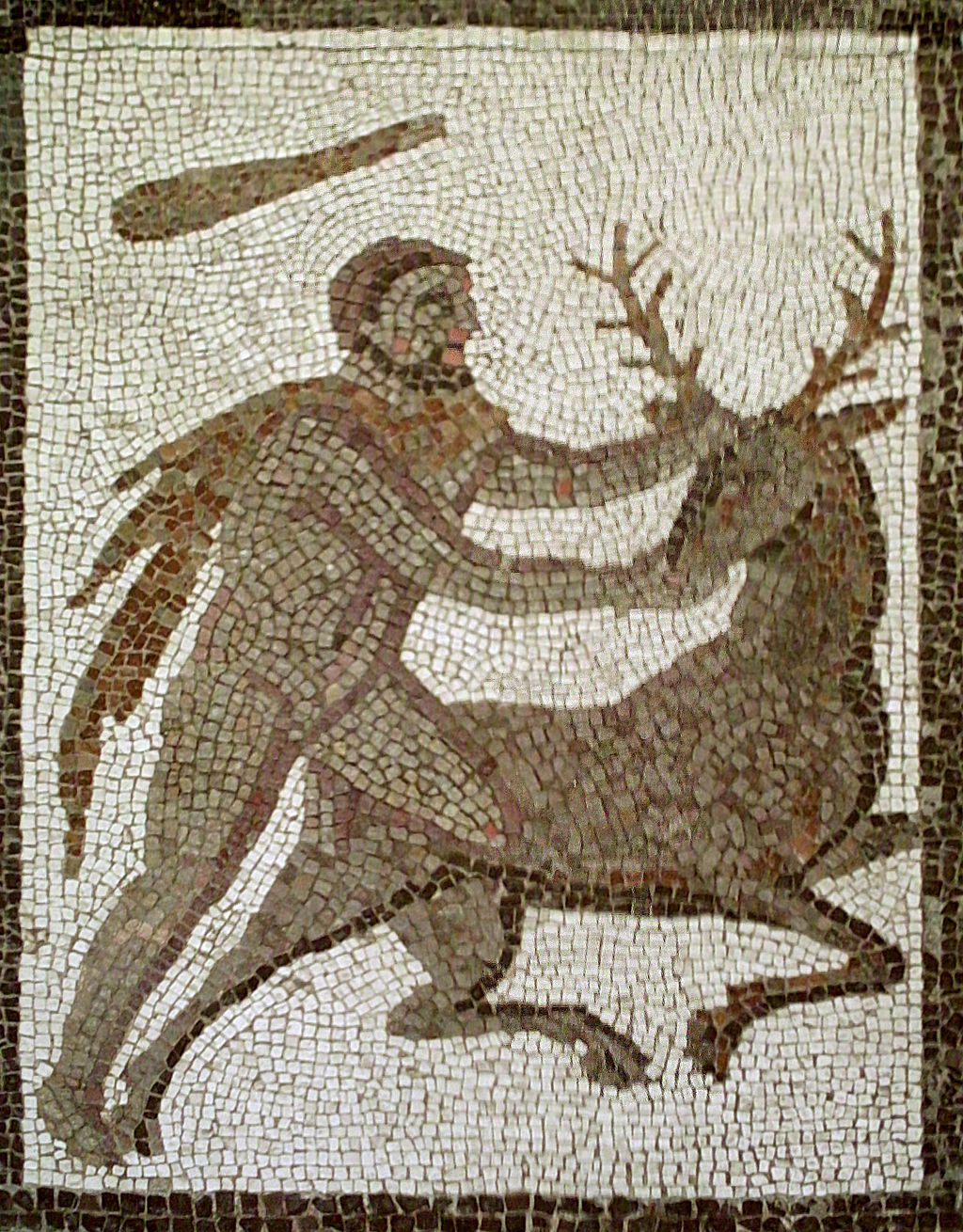
In Greek mythology, the Ceryneian hind (Ancient Greek: Κερυνῖτις ἔλαφος Kerynitis elaphos, Latin: Elaphus Cerynitis) was an extraordinary deer of Ceryneia, larger than a bull, distinguished by golden antlers resembling those of a stag, hooves of bronze or brass, and a dappled hide that shimmered as she moved. This magnificent creature "excelled in swiftness of foot" and, according to some accounts, snorted fire. To capture and bring her back alive to King Eurystheus in Mycenae constituted the third labor of Heracles, a task designed to be nearly impossible given the hind's supernatural speed and her sacred status under the protection of the goddess Artemis.
The creature was known by numerous names and epithets throughout Greek tradition, including: doe with the golden horns, golden-horned hind, Ceryneia hind, Cerynitian hind, beast with golden antlers, Parrhasian hind, nimble hind of Maenalus, and beast of Maenalus. The classical scholar Sir James George Frazer notes that the hind derived her name from the river Cerynites, "which rises in Arcadia and flows through Achaia into the sea," connecting the creature to the specific geographical region where she roamed and was ultimately hunted. According to one mythological tradition, Artemis discovered a magnificent herd of five Ceryneian hinds playing at the base of Parrhasian hill, far from the banks of the "black-pebbled Anaurus" river where they customarily grazed.
The goddess was so impressed by these extraordinary creatures that she yoked four of them to her golden chariot with golden bridles, harnessing them as divine mounts befitting her status as a major Olympian deity. However, she deliberately allowed one hind to escape to the Ceryneian hill, purposely establishing a future labor for Heracles that would test his perseverance, tracking skills, and respect for divine prohibitions. While dwelling in Ceryneia, this free-roaming hind reportedly chased farmers from their vineyards, disrupting agriculture and demonstrating her wild, untamable nature despite her beauty.
The Ceryneian hind was sacred to Artemis, the virgin goddess of the hunt, wilderness, and wild animals, making any harm to the creature a potential act of sacrilege. Some traditions held that "the hind bore the inscription 'Taygete dedicated [me] to Artemis,'" suggesting the creature was a votive offering from Taygete, one of the Pleiades who had been transformed or who had dedicated this sacred animal to the goddess. Because of the hind's sacredness and the severe divine punishment that might follow from injuring her, Heracles refused to harm the creature and instead resolved to capture her alive through sheer endurance and tracking skill rather than violence.
This decision transformed the labor into an extraordinary test of patience and determination. Heracles hunted the hind for more than a year, pursuing her in an epic chase that ranged from Oenoe through vast territories to the mythical land of Hyperborea in the far north, then to Mount Artemisius (a mountain range dividing Argolis from the plain of Mantinea), before finally cornering and capturing the hind near the river Ladon in Arcadia. Different ancient sources provide varying accounts of precisely how Heracles ultimately captured the elusive creature.
Euripides' version states that Heracles actually slew the hind and then brought her body to Artemis as an offering of propitiation, hoping to appease the goddess for this necessary sacrilege. Another tradition maintains he captured her with nets while she was sleeping, using stealth rather than speed or violence. Yet another account claims he simply ran her down through sheer endurance, outlasting even her supernatural stamina in a chase that lasted over a year.
The most commonly cited version recounts that Heracles shot and wounded her with an arrow just as she was about to cross the river Ladon, carefully maiming her legs just enough to prevent her escape without killing her, threading the narrow path between completing his labor and committing unforgivable sacrilege. Once Heracles had captured the hind, his troubles were not over. He encountered Artemis and her brother Apollo, "who would have wrested the hind from him" in anger at this violation of the sacred creature.
Only after Heracles explained to both deities that he had pursued and captured (or wounded) the sacred hind purely out of necessity—compelled by the divine command transmitted through King Eurystheus and ultimately originating from Zeus himself as punishment for Heracles' madness-induced crimes—was he granted permission to take the hind alive to Eurystheus in Mycenae. This confrontation with the divine siblings emphasized the moral complexity of Heracles' labors, where obedience to one divine command (completing the labors) sometimes necessitated apparent violation of other sacred prohibitions (harming Artemis' sacred animal), forcing the hero to navigate between competing divine authorities. Upon delivering the living hind to Eurystheus, Heracles successfully completed his third labor, demonstrating not only his physical endurance and tracking abilities but also his diplomatic skill in negotiating with offended deities and his moral constraint in refusing to unnecessarily harm a sacred creature despite the difficulty this restraint imposed on accomplishing his task.