Cat-sìth
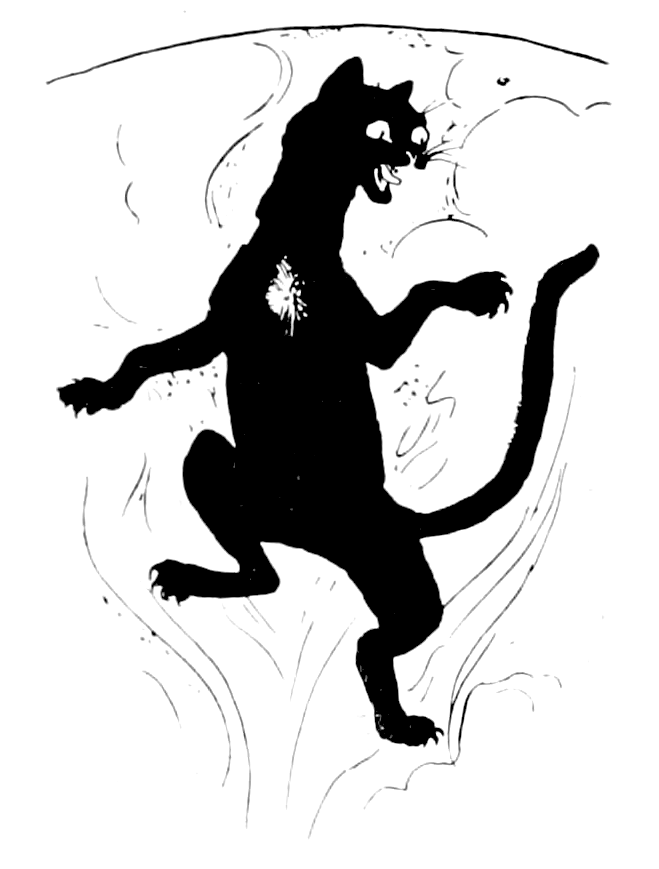
The cat-sìth (Scottish Gaelic: [kʰaʰt̪ ˈʃiː]; plural cait-shìth), known in Irish as cat sí ([kat̪ˠ ˈʃiː]), is a legendary creature from Celtic mythology. Described as a large black cat with a white spot on its chest, it is said to walk on its hind legs and haunt the Scottish Highlands. While the creature appears more often in Scottish folklore, there are also stories of it in Irish tradition.
According to legend, the cat-sìth is not always a fairy but sometimes believed to be a witch who could transform into a cat up to nine times. If the witch transformed a ninth time, they would remain in feline form permanently.
The myth may have been inspired by the Scottish wildcat, a population of the European wildcat now unique to Scotland, or by the Kellas cat, a rare hybrid of wildcat and domestic cat native to the region.
In appearance, the cat-sìth is completely black except for a distinct white patch on its chest. It is often said to be as large as a dog, with a habit of arching its back and raising its bristling fur to appear more imposing around people. When unobserved, it is known to walk upright on two legs—a detail common to many stories describing encounters with it.
A similar theme appears in the English folktale “The King of the Cats.” In the story, a man tells his wife and their cat, Old Tom, that he saw nine black cats—each with a white chest spot—carrying a tiny coffin with a crown. One cat said, “Tell Tom Tildrum that Tim Toldrum is dead.” Upon hearing this, Old Tom declares, “What?! Old Tim dead! Then I’m the King o’ the Cats!” before climbing up the chimney and disappearing forever.
In darker tales, the cat-sìth is said to steal the souls of the newly dead before they can pass into the afterlife. It was believed that if a cat-sìth crossed over a corpse before burial, it could claim the person’s soul. To prevent this, families would hold a vigil known as the Late Wake (Fèill Fhadalach in Irish Gaelic), during which people would watch over the body and try to keep the cat-sìth away. Distractions such as music, dancing, games, and even catnip were used. Lighting a fire near the body was discouraged, as the creature was thought to be drawn to warmth.
During Samhain, it was customary to leave out a saucer of milk for the cat-sìth. Doing so would ensure good fortune for the household in the coming year. Neglecting this tradition, however, was believed to bring bad luck—specifically, the cat-sìth would curse the house by drying up the milk from its cows.
While many viewed the cat-sìth as a fairy creature, others believed it to be a witch or demon in animal form, entirely separate from the fairy realm. In some versions of the lore, once a witch transformed into a cat for the ninth time, the change was permanent.
One of the darkest parts of the legend involves a demonic cat-sìth called Big Ears, who could be summoned through a ritual known as taghairm ([tɤrʲɤm] in Scottish Gaelic). To perform it, participants would burn the bodies of cats for four days and nights to call upon Big Ears, who would then grant any wish to those involved in the gruesome ceremony.