Bonnacon
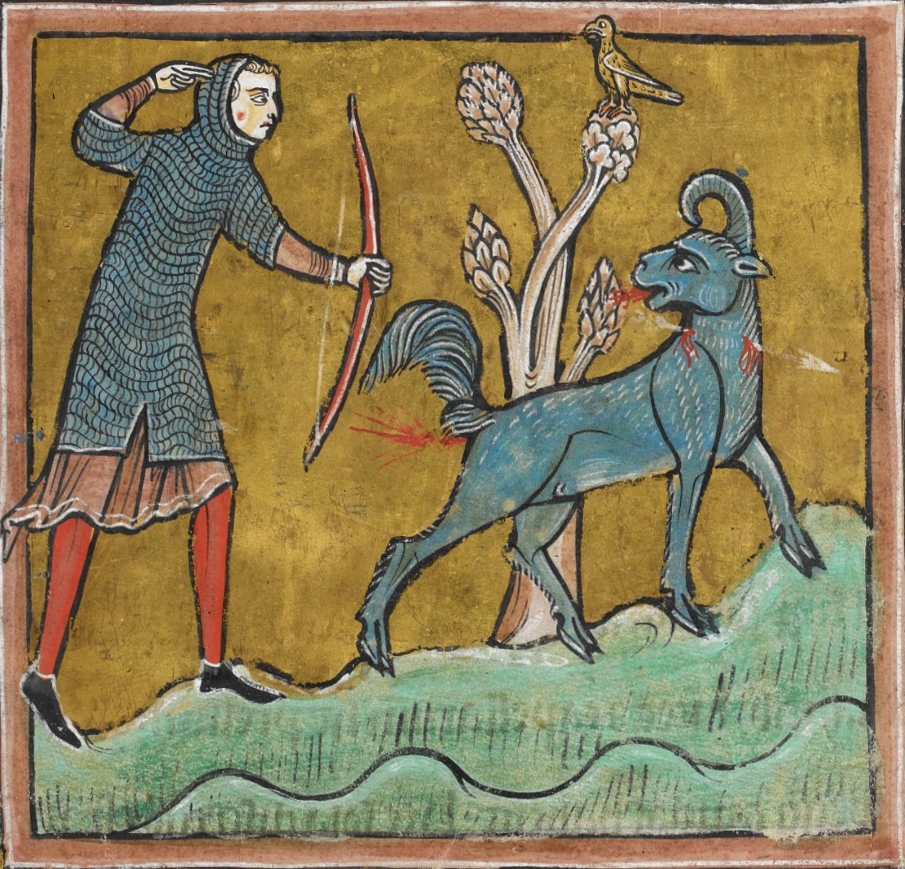
The bonnacon—also known as bonasus or bonacho (Ancient Greek: βόνασος or βόνασσος)—is a creature of medieval legend, often described as a bull with a horse-like mane and inward-curving horns that render it defenseless in combat. Its body is typically depicted in medieval bestiaries as being covered in reddish-brown or black fur.
Due to its ineffective horns, the bonnacon is said to defend itself in a rather unusual and grotesque way: by expelling a stream of burning feces from its rear to deter and injure pursuers. This caustic discharge was believed to scorch anything it touched, allowing the creature to escape unscathed.
The name "bonnacon" comes from the Greek word βόνᾱσος (bonasos), meaning bison. The term was also used by the ancient geographer Strabo, who applied it in describing Indian Zebu cattle seen during local festivals.
The earliest known description of the bonnacon appears in Pliny the Elder’s Naturalis Historia. He writes:
"There are reports of a wild animal in Paeonia called the bonasus, which has the mane of a horse, but in all other respects resembles a bull; its horns are curved back in such a manner as to be of no use for fighting, and it is said that because of this it saves itself by running away, meanwhile emitting a trail of dung that sometimes covers a distance of as much as three furlongs, contact with which scorches pursuers like a sort of fire."
Pliny’s account gained popularity during the Middle Ages, ensuring the bonnacon's place in numerous medieval bestiaries. While most entries in these bestiaries were paired with moral or religious allegories, the bonnacon stood apart: its bizarre defense mechanism appears to have been included largely for humor, especially in illustrations where the startled reactions of hunters add to the comic effect.
The Aberdeen Bestiary, for example, echoes Pliny’s description but places the creature in Asia rather than Paeonia. It reads:
"In Asia an animal is found which men call bonnacon. It has the head of a bull, and thereafter its whole body is of the size of a bull’s with the maned neck of a horse. Its horns are convoluted, curling back on themselves in such a way that if anyone comes up against it, he is not harmed.
But the protection which its forehead denies this monster is furnished by its bowels. For when it turns to flee, it discharges fumes from the excrement of its belly over a distance of three acres, the heat of which sets fire to anything it touches. In this way, it drives off its pursuers with its harmful excrement."
The bonnacon also appears in Christian lore. In the Golden Legend, a 13th-century collection of saints’ lives compiled by Jacobus de Voragine, the creature is mentioned in the story of Saint Martha. There, she encounters and tames the Tarasque, a dragon-like beast said to be the offspring of the biblical Leviathan and the bonnacon—called bonacho or onacho in this version. In that account, the bonnacon is said to hail from Galatia, a region in central Anatolia.