Blas de Lezo
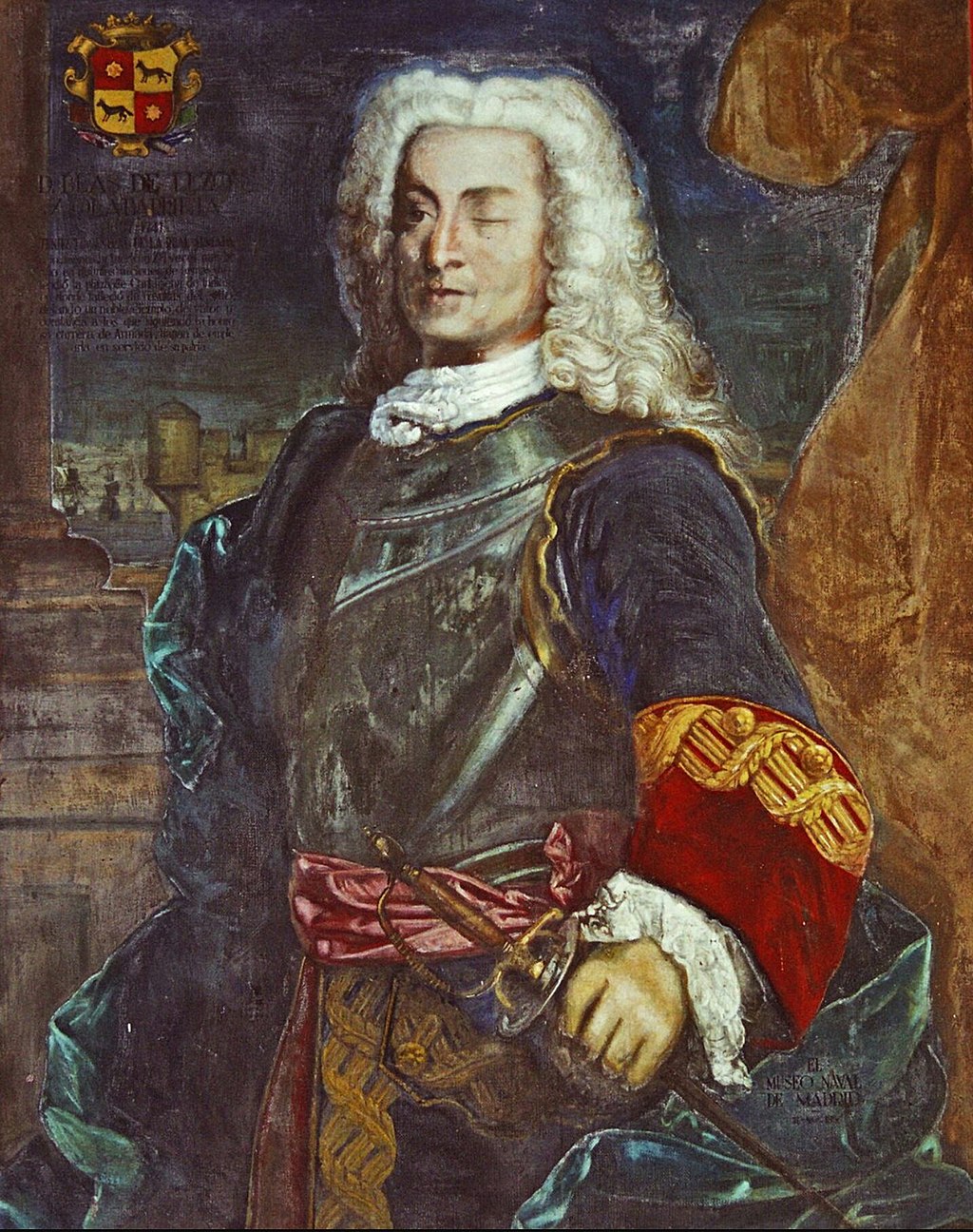
Admiral Blas de Lezo y Olavarrieta (February 3, 1689 – September 7, 1741) was a Spanish Navy officer best known for his extraordinary victory at the Battle of Cartagena de Indias in 1741, where forces under his command decisively defeated a massive British invasion fleet under Admiral Edward Vernon. This stunning triumph prevented Britain from seizing one of Spain's most valuable colonial ports and represented one of the greatest Spanish military victories of the eighteenth century, though it has been largely overlooked in English-language histories that prefer not to dwell on this humiliating British defeat. Throughout his remarkably combative naval career spanning four decades of nearly continuous warfare, Lezo sustained devastating wounds that would have ended the military service of most men.
He lost his left eye to shrapnel during the Battle of Vélez-Málaga in 1704 when he was only fifteen years old, serving as a midshipman. He lost complete mobility of his right arm after being severely wounded during the siege of Barcelona in 1714. Most dramatically, his left leg was amputated in situ—without anesthesia on the battlefield—after being shattered by a cannonball projectile during the siege of Toulon in 1707, leaving him dependent on a wooden prosthetic for the rest of his life.
Rather than viewing these catastrophic injuries as reasons for retirement or as sources of shame, Lezo perceived his wounds and physical limitations as medals of honor earned through service to Spain, visible testaments to his courage and sacrifice. He deliberately refused to wear an eye patch to conceal his blind eye, and he displayed his other disabilities openly, wearing his battle history literally on his flesh. This uncompromising attitude won him profound respect from both his peers among the Spanish officer corps and the ordinary soldiers and sailors who served under his command, who saw in his scarred and mutilated body proof of his willingness to share their dangers and hardships.
Lezo habitually declared that "the lack of a leg does not imply the lack of a brave heart," asserting that physical disability bore no relationship to martial courage or strategic capability. According to contemporary accounts, he sometimes invoked the example of the famous Dutch admiral Cornelis Jol, nicknamed "Peg Leg" (Houtebeen in Dutch) because of the wooden prosthesis he wore, as proof that a sailor could undertake great enterprises and achieve tremendous renown—Jol had earned fearsome reputation as a highly successful pirate and privateer despite his amputation—demonstrating that theoretical physical disability posed no inherent barrier to maritime achievement or command authority. Lezo's masterful defense of Cartagena de Indias against Admiral Vernon's vastly larger invasion force—which included approximately 186 ships carrying over 27,000 soldiers and sailors, making it one of the largest amphibious operations in history prior to the twentieth century—consolidated his enduring legacy as one of the most prominent and capable military commanders in Spanish history.
Despite being dramatically outnumbered, with perhaps 3,000 regular troops and 600 militia plus local volunteers and enslaved laborers pressed into defensive work, and despite Vernon's confident prediction of easy victory (he had commemorative medals struck before the battle depicting his anticipated triumph), Lezo's brilliant defensive strategy, skillful use of Cartagena's fortifications, tactical improvisation, and indomitable will to resist led to the siege's failure after two months of costly British assaults. Vernon's forces suffered devastating casualties from Spanish resistance, tropical disease, and the brutal climate, ultimately forcing the British to withdraw in disgrace, having lost thousands of men without capturing the city. This stunning victory saved Cartagena and by extension Spain's entire South American colonial system from potential British conquest and permanently altered the balance of colonial power in the Caribbean, yet Lezo received surprisingly limited recognition from the Spanish crown during his brief remaining lifetime—he died just months after the battle, possibly from wounds or disease contracted during the siege.
Nevertheless, later generations recognized the magnitude of his achievement, and he is now celebrated as one of Spain's finest naval officers and military leaders, embodying courage, tactical genius, and determination in the face of overwhelming odds. His story has experienced renewed attention in recent decades as historians have rediscovered this largely forgotten epic of Spanish military history and as Spain has sought to commemorate Lezo's achievements through statues, including a prominent monument erected in Madrid in 2014, finally according him the recognition his extraordinary career and decisive victory deserve.