Bellerophon
Bellerophon (also spelled Bellerophontes; Ancient Greek: Βελλεροφῶν, Βελλεροφόντης, literally meaning "slayer of Belleros") or Hipponous (Ancient Greek: Ἱππόνοος, literally "horse-knower") was a divine hero of Corinth in Greek mythology, the son of the sea god Poseidon and Eurynome, and the foster son of King Glaukos who raised him as his own. Within the chronology of Greek heroic legends, Bellerophon was celebrated as "the greatest hero and slayer of monsters, alongside Cadmus and Perseus, before the days of Heracles," representing the generation of monster-slaying heroes who preceded the most famous of all Greek heroes and whose exploits established the pattern that Heracles would later follow and surpass. Among Bellerophon's greatest and most celebrated feats was his killing of the fearsome Chimera, the fire-breathing hybrid monster featured in Homer's Iliad.
Homer depicted this terrifying creature as possessing a lion's head in front, a goat's body rising from its back, and a serpent's tail, creating a nightmarish composite of three dangerous animals. The poet emphasized the monster's deadliness by describing how "her breath came out in terrible blasts of burning flame," making the Chimera capable of incinerating opponents from a distance and rendering conventional heroic combat approaches suicidal. Bellerophon's victory over this seemingly invincible monster—achieved by riding above it on Pegasus and shooting arrows or, in some versions, dropping lead into its fiery throat where the heat melted the metal and choked the beast—demonstrated both his courage and his tactical ingenuity in finding unconventional solutions to impossible challenges.
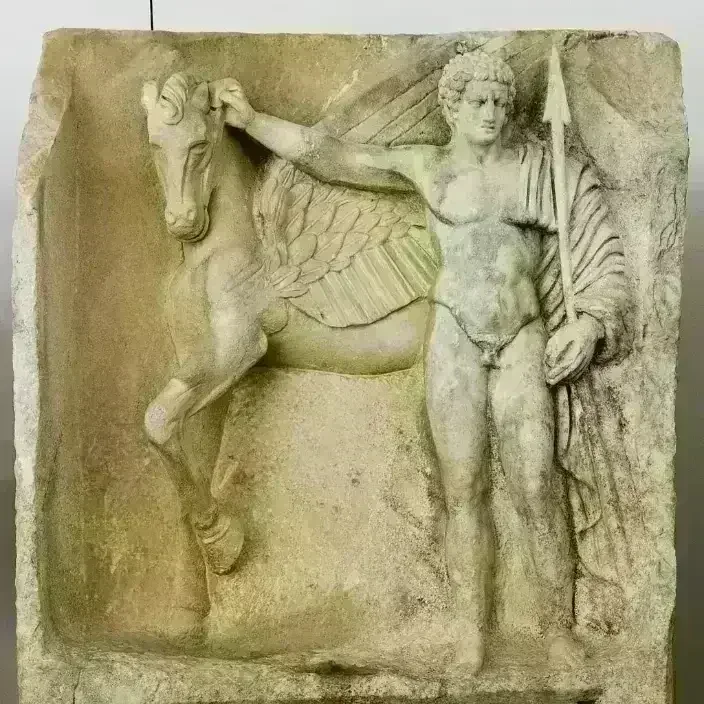
Bellerophon was also renowned for his capture and taming of Pegasus, the magnificent winged horse that had sprung from the blood of the Gorgon Medusa when Perseus beheaded her. This achievement, which no other mortal had accomplished despite many attempts, was made possible through divine assistance: the goddess Athena appeared to Bellerophon in a dream or vision and presented him with a golden bridle enchanted with her divine power. With this magical bridle, Bellerophon was able to approach, mount, and tame the previously wild and unapproachable Pegasus, forging a partnership between hero and divine steed that enabled his subsequent monster-slaying exploits and elevated him above ordinary mortal heroes who fought on foot or with earthbound horses.
However, Bellerophon's story ultimately became a cautionary tale about the dangers of hubris—excessive pride and the overstepping of mortal boundaries. After his spectacular successes in slaying the Chimera and completing various other seemingly impossible tasks assigned to him, Bellerophon grew arrogant and forgot the proper humility that mortals should maintain before the gods. In his pride, he attempted to ride Pegasus up to Mount Olympus itself, the sacred home of the immortal gods that was forbidden to mortals, apparently believing that his heroic achievements entitled him to join the company of the gods as an equal or that he had transcended his mortal nature through his extraordinary deeds.
This presumptuous attempt to violate the fundamental boundary between mortal and divine realms earned Bellerophon the profound disfavor and anger of the gods, particularly Zeus, who would not tolerate such transgression of cosmic order. According to most versions of the myth, Zeus sent a gadfly or some other stinging insect to torment Pegasus, causing the horse to buck violently and throw Bellerophon from his back. The hero fell from the great height, plummeting back to earth in a catastrophic descent that left him crippled, blinded, or otherwise permanently injured.
He spent the remainder of his days as a broken, wandering outcast, shunned by both gods and men, living in misery and obscurity—a dramatic reversal from his earlier glory that illustrated the severe consequences awaiting mortals who allowed success to inflate their pride beyond appropriate limits and who failed to respect the eternal distinctions that separated human from divine. Bellerophon's tragic downfall thus served Greek culture as a powerful mythological warning about the necessity of maintaining proper humility and accepting one's mortal limitations regardless of one's achievements, demonstrating that even the greatest heroes could be utterly destroyed if they forgot their place in the cosmic hierarchy and challenged the prerogatives of the immortal gods.