Beast of Gévaudan
The Beast of Gévaudan (French: La Bête du Gévaudan, IPA: [la bɛt dy ʒevodɑ̃]; Occitan: La Bèstia de Gavaudan) is the historic name given to a man-eating creature or group of creatures that terrorized the former French province of Gévaudan between 1764 and 1767. This region included what is now the department of Lozère and part of Haute-Loire, located in the Margeride Mountains of south-central France.
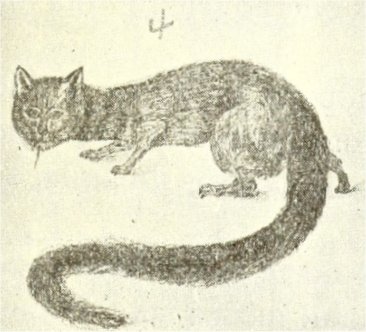
The attacks covered an area roughly 90 by 80 kilometers (56 by 50 miles) and were attributed to one or more beasts described by witnesses as having tawny or russet fur streaked with black, a dark stripe running down the back, and a long tail tipped with a tuft of fur that exceeded the length of a wolf’s. Accounts claimed the creature was the size of a calf or cow, capable of bounding or leaping across fields toward its victims, and attacking with formidable teeth and claws. Contemporary descriptions suggest the beast might have been a young lion, a striped hyena, a large wolf, a massive dog, or a wolfdog hybrid.
Despite numerous theories, its identity remains an enduring mystery.
The Kingdom of France devoted significant resources to the hunt, enlisting nobles, soldiers, royal huntsmen, and local civilians. Historical records disagree on the number of victims. A 1987 study estimated 210 attacks, resulting in 113 deaths and 49 injuries, with 98 of the dead partially eaten. Other accounts place the death toll between 60 and 100 adults and children, with over 30 more injured. Many victims were killed by having their throats torn out. Several animals believed to be the beast were killed, yet the attacks only ceased after years of effort.
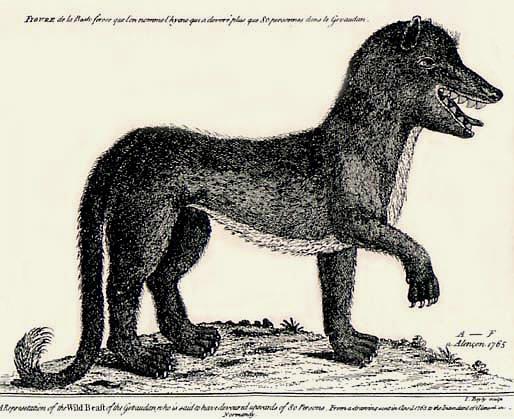
Descriptions from the time vary widely, possibly due to hysteria and sensationalism in public reports. Although none of the slain animals were preserved, the beast was generally depicted as a wolf-like canine with a tall, lean frame and long stride. It was said to be as large as a calf, a cow, or even a horse.
Witnesses described an elongated head like that of a greyhound, a flattened snout, pointed ears, and a wide mouth set on a broad chest. The fur was typically described as tawny or russet with black streaking, and a distinct white heart-shaped marking on the underbelly.
Many tales claimed the beast could not be killed. Even after being struck by bullets from skilled marksmen, it was said to rise and continue the attack. Some reports suggested it could appear in different locations within short spans of time, though this may have been due to the distances being within reach of a single animal.
Unusually for a predator, the beast often showed little fear of humans. Until the hunter François Antoine’s intervention, it sometimes lingered near people, retreating only a short distance when resisted and even sitting back on its haunches before resuming the charge. It frequently attacked victims in broad daylight, sometimes in the very center of villages.
The persistence of its assaults suggested that hunger was not always the motive. Known for extraordinary agility, it could leap over walls too high for an ordinary dog to cross, adding to its fearsome reputation.