Arion
In the cultural history of ancient Greece, Arion of Methymna occupies a unique space, straddling the line between historical innovator and mythological hero. A native of Lesbos and a celebrated kitharode (lyre-player), Arion is historically credited with transforming the dithyramb from a folk tradition into a formal art. However, he is most famously remembered for the fantastical legend of his rescue at sea by a dolphin, a narrative that has persisted as one of antiquity’s most enduring folktales.
While his biography is largely obscured by legend, ancient sources consistently identify Arion as a contemporary and friend of Periander, the tyrant of Corinth. His musical reputation was peerless; Herodotus described him as "second to none of the lyre-players in his time." Arion’s most significant contribution to literature was the formalization of the dithyramb, a choral hymn dedicated to Dionysus. Although the form predated him, Arion is said to have imposed artistic structure upon it, introducing a circular chorus of fifty performers dressed as satyrs.
This innovation, according to ancient scholars, linked the dithyramb to the origins of tragedy. Later traditions underscored this connection to the kuklios choros (circular chorus) by symbolically naming his father "Kukleus."
The defining myth of Arion’s life occurred following a successful musical tour in Sicily. Laden with prizes and wealth, Arion engaged a Corinthian ship to return to Periander's court. During the voyage, the crew plotted to murder the poet and seize his fortune.
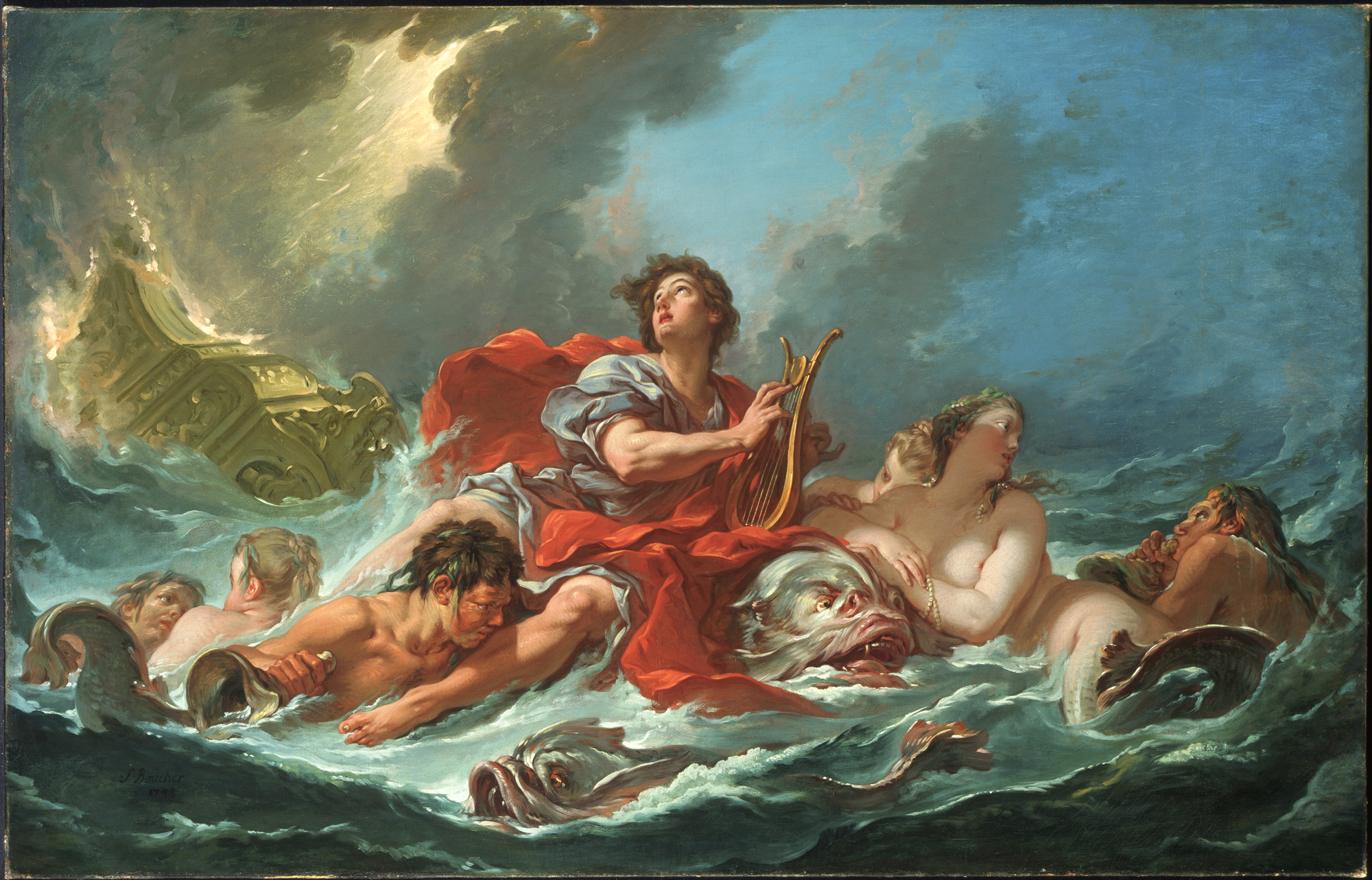
Presented with the choice of suicide or execution, Arion requested permission to perform a final composition. Clad in his professional regalia and playing his kithara, he sang a hymn to Apollo. The music attracted a school of dolphins to the vessel.
Trusting in providence, Arion leaped into the sea, where he was borne by a dolphin to the sanctuary of Poseidon at Cape Tainaron.
The narrative concludes with the exposure of the sailors' treachery. Upon returning to Corinth, Arion recounted his survival to Periander. When the ship eventually arrived, the tyrant interrogated the crew, who falsely claimed Arion was prospering in Italy.
Arion then revealed himself, still wearing the robes in which he had entered the sea. Struck by this apparent divine intervention, the sailors were executed. In recognition of the miracle, Apollo is said to have catasterized Arion and the dolphin as the constellation Delphinus.
While early thinkers such as Augustine of Hippo accepted the story’s historicity, modern scholarship generally views it as a folkloric motif associated with Apollo and Dionysus, sharing thematic elements with myths such as the founding of Taras and the Dionysian transformation of Tyrrhenian pirates. Regardless of its historical veracity, the tale cements Arion’s legacy as a figure favored by the gods, a master of art capable of charming nature itself.