Antarah ibn Shaddad
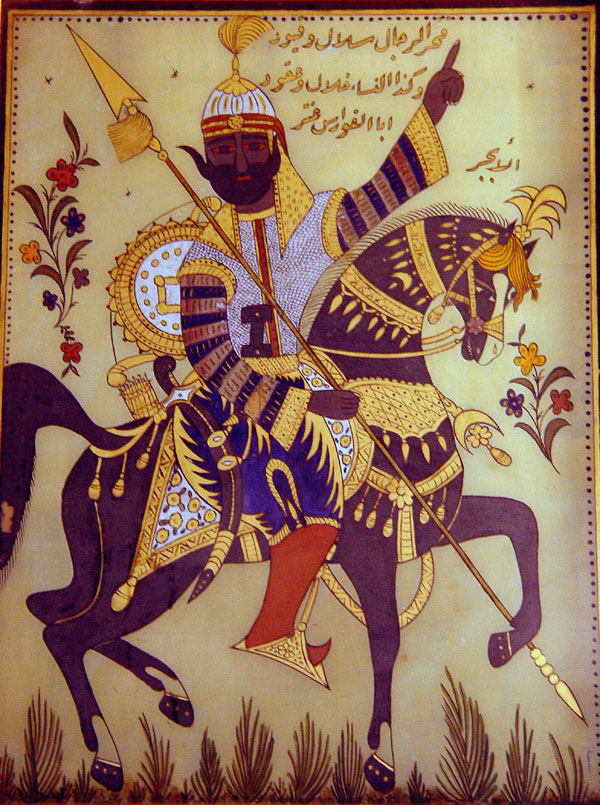
Antarah ibn Shaddad is a legendary figure from Al-Qassim Province, Saudi Arabia, dated to ~525 AD (Middle Ages).
Antarah ibn Shaddad al-Absi (Arabic: عَنْتَرَة بن شَدَّاد الْعَبْسِيّ, romanized: ʿantara ibn šaddād al-ʿabsiyy; 525–608 AD), commonly known as ʿAntar, was a pre-Islamic Arabian poet and warrior whose literary achievements and dramatic life story have captivated audiences for centuries. His most celebrated poem appears in the Mu'allaqāt, the collection of seven legendary "hanging odes" said to have been displayed in the Kaaba at Mecca. The tale of his life became the foundation for an elaborate and enduring romance that continues to resonate throughout Arab culture.
Born in Najd on the Arabian Peninsula, ʿAntarah came into the world with a divided heritage. His father, Shaddād al-ʿAbsī, was an Arab warrior of standing within the Banu Abs tribe under their chief Zuhayr, while his mother, Zabībah, was an Ethiopian woman. Described as one of the three "Arab crows" (Aghribah al-'Arab)—a term for distinguished Arabs of dark complexion—ʿAntarah grew up enslaved despite his father's status.
He fell deeply in love with his cousin ʿAbla, but his position as a slave made marriage impossible. He also earned the hostility of Sumayya, his father's wife. Nevertheless, through his exceptional personal qualities and battlefield courage, he commanded respect, distinguishing himself as both an accomplished poet and a formidable warrior.
The turning point in ʿAntarah's life came when the Tayy tribe invaded Banu ʿAbs territory at the outbreak of the Dahis and al-Ghabra war. When his father commanded, "ʿAntarah, fight with the warriors," he responded with bitter irony: "The slave doesn't know how to invade or how to defend, but is only good for milking goats and serving his masters." His father's answer changed everything: "Defend your tribe, O ʿAntar, and you are free." ʿAntarah fought fiercely, and his tribe defeated the attackers. Having won his freedom, ʿAntarah sought permission to marry ʿAbla, the cousin who inspired his most passionate love poetry.
To prove himself worthy, he faced formidable challenges, including retrieving a rare breed of camel from the Northern Arab Lakhmid Kingdom, then ruled by al-Nu'man III ibn al-Mundhir. ʿAntarah's poetry has been remarkably well preserved and reveals his preoccupation with chivalrous ideals, courage, heroism in combat, and above all his devotion to ʿAbla. His fame was secured when one of his works was included in the Mu'allaqat, the revered collection legendarily suspended in the Kaaba.
His verse holds particular historical and cultural significance for its vivid descriptions of battles, armor, weaponry, horses, desert landscapes, and other aspects of his era. The circumstances of ʿAntarah's death remain disputed. According to Ibn Duraid, he was killed either by Wasr ibn Jabir or in battle against the Tayy tribe, while Abu Obeida claims he died peacefully of old age.
The romance of ʿAntar and ʿAbla was elaborated into an epic poetic saga traditionally attributed to al-Asmaʿi, a poet at the court of Caliph Hārūn al-Rashīd. Traditional storytellers still recite it in Arab coffeehouses, and its cultural importance has been likened to the Arthurian romances in English literature. His legendary house and stable became particularly famous.
One of Bethlehem's seven clans, the Anatreh, takes its name from ʿAntarah and once served as guardians of the Church of the Nativity.