Amphisbaena
In European folklore and heraldry, the Amphisbaena is a legendary reptile known for having a head at each end of its body. This creature appears prominently in medieval bestiaries and legends, also going by the name Amphivena. Both names derive from Greek words meaning "to go both ways." In his epic Pharsalia, the classical poet Lucan placed this creature in the North African deserts, where it reproduced like other reptiles by laying eggs in the sand.
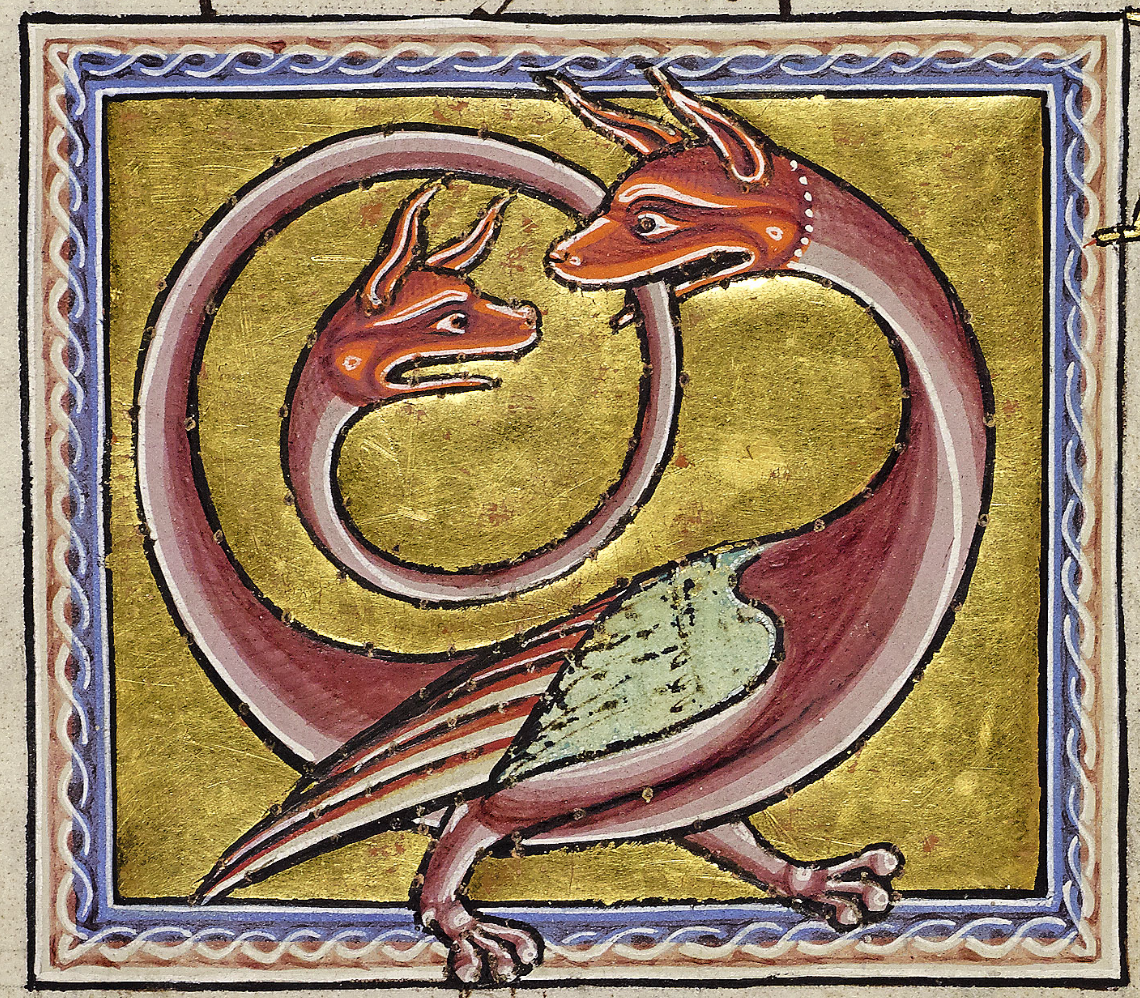
Medieval bestiaries commonly depicted the Amphisbaena in their illuminated margins as a winged, bipedal dragon bearing a second head at the tip of its serpentine tail. This tail-head typically gripped the primary head in its jaws, forming a loop that allowed the creature to roll across the ground like a wheel. With powerful eagle-like talons and legs, it proved a dangerous opponent, able to move at remarkable speed in any direction.
Its venomous bite posed a deadly threat, and its luminous eyes pierced even complete darkness, offering no refuge to potential victims. Both Pliny the Elder and Lucan documented the Amphisbaena's purported medicinal properties. According to their accounts, its dried hide could treat rheumatism, while a living specimen served as a fertility charm.
Though travelers' exaggerated tales inflated this creature to legendary proportions, it likely originated from observations of an actual Libyan desert reptile—one capable of bidirectional movement and known for raising its tail defensively to resemble a second head when threatened.