Al-Mi'raj
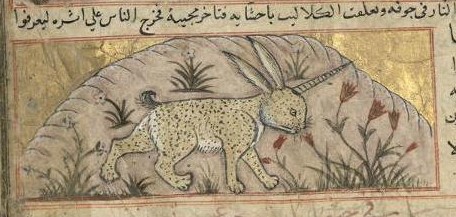
Al-Mi'raj or Almiraj (Arabic: ٱلْمِعْرَاج; al-miʿrāj) is a mythical creature from medieval Arabic literature that resembles a large hare or rabbit distinguished by a single horn protruding from its head, combining the general form of a familiar animal with the fantastical element of a unicorn-like horn. This curious beast appears in various Arabic geographical, zoological, and legendary texts from the medieval Islamic world, where it occupies a place among the numerous fantastic creatures that populated medieval Islamic cosmography alongside more familiar animals in works that blended genuine natural history observation with travelers' tales, legendary material, and pure imagination. The name "al-Mi'raj" appears in one version of the Alexander Romance—the widespread legendary cycle recounting fantastical adventures attributed to Alexander the Great, known in Arabic literature as Iskandar—where the creature is situated on Dragon Island in the Indian Ocean.
According to this legend, after Iskandar defeated a fearsome dragon that had been terrorizing and devouring the livestock of the island's inhabitants, the grateful islanders presented him with an al-Mi'raj as a precious gift in recognition of his heroic service, demonstrating both the creature's rarity and value and the inhabitants' gratitude to the legendary conqueror. The creature is also described as possessing the remarkable supernatural property of causing all animals that set sight upon it to flee in terror despite the al-Mi'raj's relatively small size and herbivorous hare-like nature, suggesting that it radiates some kind of awe-inspiring or fear-inducing aura that affects other creatures instinctively. The creature appears under various circumstances, names, and locations depending on which medieval Arabic text or manuscript version one consults, reflecting the fluid nature of medieval legendary material that circulated orally and in written form across the Islamic world and was adapted, embellished, and modified by successive storytellers, scribes, and compilers working in different regions and time periods.
According to Zakariya al-Qazwini's influential cosmographical work "ʿAjā'ib al-makhlūqāt wa-gharā'ib al-mawjūdāt" (Marvels of Things Created and Miraculous Aspects of Things Existing), compiled around 1260 CE and commonly known in English as "The Wonders of Creation," the al-miʿrāj is a beast purported to inhabit an island called Jazīrat al-Tinnīn (literally "Island of the Sea-Serpent" or "Dragon Island") located somewhere in the Indian Ocean. Qazwini's work, which represented one of medieval Islam's most comprehensive attempts to catalog the entire created world including its wonders, marvels, and strange creatures, enjoyed enormous popularity and influenced subsequent Islamic cosmographical and geographical literature for centuries. In Qazwini's description, the al-Mi'raj is said to resemble a yellow hare or rabbit in general body shape and size, but distinguished by possessing a single prominent black horn emerging from its head like a unicorn's horn.
The text emphasizes that all wild beasts and animals fled at the mere sight of this creature despite its relatively innocuous rabbit-like appearance, suggesting that the horn possessed magical properties or that the al-Mi'raj emanated supernatural power that instinctively terrified other creatures—a characteristic that the al-Mi'raj shares with another unicorn creature from Arabic literature called the karkadann (often identified with the rhinoceros but described with magical properties), which was also reputed to cause other animals to flee in terror from its presence. According to Qazwini's version of the legend, the inhabitants of Dragon Island made a gift of the al-Mi'raj to Iskandar (Alexander the Great) after the legendary conqueror helped them kill a dragon or enormous serpent that had been systematically devouring their livestock and terrorizing their community, demonstrating both Iskandar's heroism and the islanders' gratitude through the presentation of this rare and wondrous creature. Different versions and names of this horned hare creature appear in other medieval Arabic geographical and legendary texts.
In one recension (textual version) of the famous geographer al-Idrisi's "Nuzhat al-Mushtāq fī Ikhtirāq al-Āfāq" (commonly translated as "The Book of Pleasant Journeys into Faraway Lands" or "The Pleasure Excursion of One Who Is Eager to Traverse the Regions of the World"), compiled around 1154 CE for the Norman King Roger II of Sicily and representing one of medieval geography's most comprehensive works, the horned hare is called ʿarāj (Arabic: عرَاج) rather than al-Mi'raj. In this version, the dragon-inhabited island is called Mustashiayn (rendered in French scholarly sources as "Mostachiin"; Arabic: مستشيين) and is situated not in the Indian Ocean as in Qazwini's account but rather somewhere in Western Africa, demonstrating how legendary geography often relocated fabulous creatures and islands to different regions depending on the compiler's sources, purposes, and geographical knowledge. In al-Idrisi's account, Iskandar—here also identified by his Quranic epithet Dhu'l-Qarnayn, meaning "The Two-Horned One," referring to Alexander's iconographic representation with ram's horns in ancient art that was reinterpreted in Islamic tradition as indicating either his conquest of the world's two "horns" (east and west) or his righteousness and power—defeats the dragon through essentially the same clever stratagem described in Qazwini's version.
Rather than confronting the monster directly in combat, Iskandar prepares two sacrificial oxen by stuffing their carcasses with active chemical substances (various medieval sources mention different materials including quicklime, sulfur, naphtha, or other incendiary or caustic substances), and then offers these prepared carcasses to the dragon as bait. When the dragon devours the stuffed oxen, the reactive substances "ignite fire inside the [monster's] entrails," causing internal combustion or chemical burning that kills the beast from within—a tale that demonstrates both Iskandar's cunning intelligence in finding an indirect solution to a problem that could not be solved through direct force, and medieval Islamic interest in chemical and incendiary warfare technologies that were being developed during this period. In a modern scholarly edition of al-Idrisi's geographical work, the name given for the horned hare creature is baqrāj (Arabic: بقراج) rather than either al-Mi'raj or ʿarāj, though the basic description remains similar, illustrating the textual variations and possible copyist errors or regional dialect differences that characterize medieval manuscript traditions where texts were hand-copied repeatedly and names could be corrupted or changed through transcription errors or scribal "corrections." However, this version differs significantly in the circumstances and context of how Iskandar obtained the creature.
Rather than receiving the baqrāj as a gift after killing a dragon, this account states that Iskandar had traveled to an island called Lāqā where he harvested aloeswood (a precious aromatic resin-producing tree highly valued in medieval Islamic perfumery, medicine, and incense production). Initially, the harvested aloeswood failed to produce the expected fragrance, disappointing the expedition, but after the ships departed from the island, the wood mysteriously transformed into fine-scented, dense black aloeswood of the highest quality—a magical or miraculous transformation suggesting that Lāqā was an enchanted island where natural laws operated differently. Iskandar then traded the finest specimens of this precious aloeswood along with various other exotic goods he had collected, and among these trading acquisitions was the baqrāj, described as resembling a hare in general form and size but distinguished by possessing a coat of gleaming, shiny gold rather than normal fur, and bearing a single prominent black horn.
Like the other versions, this baqrāj caused all wild animals—whether predators, herbivorous mammals, or birds—to flee in terror upon seeing it, preserving the creature's fundamental characteristic of inspiring supernatural fear despite its small, seemingly harmless rabbit-like appearance. These various medieval Arabic accounts of the horned hare creature, whether called al-Mi'raj, ʿarāj, or baqrāj, situated in the Indian Ocean or West Africa, and obtained through dragon-slaying heroism or exotic trade, reflect the complex nature of medieval Islamic geographical and zoological literature, which combined genuine observations of real animals and places with legendary material drawn from ancient sources including Greek, Persian, and Indian traditions, travelers' exaggerated or misunderstood accounts of unfamiliar creatures, and pure imaginative elaboration designed to entertain readers and emphasize the marvels and wonders of God's creation. The al-Mi'raj belongs to a category of creatures that medieval Islamic scholars and audiences apparently regarded as real, if rarely seen, animals inhabiting distant and exotic regions rather than as purely mythological inventions, though modern readers recognize it as belonging to the realm of fantasy and legend—a unicorn-hare that never existed except in the medieval Islamic geographical imagination where it served to populate the world's distant islands and unknown regions with wonders appropriate to places that lay beyond ordinary human experience and knowledge.