Afanc
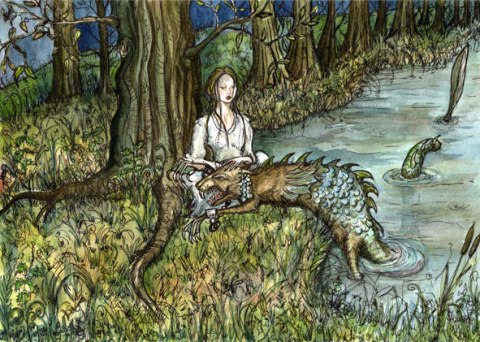
The Afanc (Welsh: [ˈavaŋk], sometimes spelled Addanc [ˈaðaŋk]) is a lake-dwelling creature from Welsh mythology. Its appearance varies across sources—some describe it as resembling a crocodile, beaver, or dwarf-like being, while others liken it to a platypus or call it a demon. The lake it inhabits also changes depending on the legend, with locations including Llyn Llion, Llyn Barfog, Llyn yr Afanc near Betws-y-Coed, and a pool by Brynberian Bridge.
Like many lake monsters, the Afanc was believed to attack anyone foolish enough to enter its waters. One of the earliest mentions comes from 15th-century poet Lewys Glyn Cothi, who placed the creature in Llyn Syfaddon in Powys.
In one tale, the Afanc is subdued by a brave maiden who allows it to rest its head on her lap. As it sleeps, villagers bind the beast in chains. When it wakes and struggles, it kills the maiden in a fit of rage before being dragged away to Cwm Ffynnon—or in some versions, slain by the hero Peredur.
In the tale Peredur son of Efrawg, found in the Mabinogion and translated by Lady Charlotte Guest, the Addanc (a variant name for the Afanc) lives in a cave near the “Palace of the Sons of the King of the Tortures.” There, it kills the king’s three sons daily, only for the maidens of the court to revive them each night. When Peredur offers to join their hunt for the beast, the chieftains refuse, knowing they cannot bring him back to life if he is slain.
Determined, Peredur ventures alone to confront the Addanc. Along the way, he meets a maiden—later revealed to be the Queen of Constantinople—who warns him that the beast is invisible and attacks with poison darts. She gives him an adder stone that reveals the creature. Using the stone, Peredur locates, wounds, and beheads the Addanc. When the three chieftains arrive, they confirm that this victory had long been foretold.
In another version recorded by the 18th-century myth collector Iolo Morganwg (Edward Williams), the Afanc’s violent thrashings cause a massive flood that drowns nearly all of Britain, sparing only Dwyfan and Dwyfach, ancestors of the later people of Prydain. Morganwg also tells of Hu Gadarn, whose mighty oxen pull the Afanc from Llyn Llion. Once removed from the water, the creature loses its power and is killed.
The name Afanc comes from the Middle Welsh avanc, which is also used in the Red Book of Hergest and other medieval texts. In Modern Welsh, afanc now means “beaver,” though it originally referred to this mythical beast. The variant addanc appears in the White Book of Rhydderch, but afanc remains the most widely used form in legends.